Thursday, 24 August 2023

Un-.zip-ping and un-.box-ing the risks associated with new TLDs

Introduction

A few weeks on from the launch of the .zip domain extension (an example of a 'top-level domain', or TLD), and just as the .box TLD is set to launch, we consider the cybersecurity and infringement risks presented by the new registrations.

.zip is one of the most recent in a long line of new TLDs launched since the start of the new-gTLD programme in 2012[1], entering its General Availability phase (in which domain registrations are open to all) on 10-May-2023[2].

The reason for concern with this particular extension is the potential for confusion with a digital file suffix commonly used for compressed or archive data files ('zip files') and the possibility that this confusion may be exploited by bad actors to drive Internet users to their own content, distribute malware, and/or create brand infringements.

These types of abuse can be manifested in a range of different ways:

  • Many platforms and e-mail clients will automatically convert certain types of string into URLs, so a legitimate filename such as document.zip could be interpreted as a URL which, when clicked, may drive users to the corresponding domain name if registered[3,4]. Similarly, if a user searches for a non-existent zip-file name, file explorer applications may instead perform an online search directing the user to a corresponding .zip domain name.
  • The DNS queries associated with a link-click can provide information to the site owner on the name of the file being requested, which could correspondingly result in a leakage of sensitive information[5]. This may be particularly effective if the second-level name ('SLD') of the registered domain (i.e. the part of the domain name before the dot) is a file extension (such as .doc) in its own right - e.g. a domain such as doc.zip might allow the site owner to see that a file such as sensitivedocumentname.doc.zip has been requested.
  • The TLD presents the possibility for a link to a potentially malicious .zip domain to easily be disguised as a link to a zip file on a trusted website[6], or as content embedded in a malicious e-mail.
  • Domains hosted on the .zip TLD may be more likely to be trusted by users based on their familiarity with regular zip files.
  • Conversely, as the .zip extension becomes more well-known, users may unknowingly download a zip file - which can contain arbitrary content of unknown legitimacy - thinking that they are simply clicking on a link to a regular website[7].

Domains on the .zip extension are being offered by Google Domains[8], together with a number of others - including .mov, which launched on the same day, and is subject to similar security concerns due to the possibility of confusion with the video-file format suffix. Despite the claim that the domain extension is intended to represent content from providers who are "fast, efficient, and ready to move", the risks - combined with other Google offerings which are attractive to would-be attackers, such as a whois privacy service and subdomain forwarding - mean that the domains on this new TLD may warrant careful scrutiny.

In a similar vein, the .box domain extension is set to enter its Sunrise phase - where brand owners can apply for new domains, prior to General Availability - on 09-Aug-2023[9]. Whilst not a file suffix in the same way as .zip, the .box extension is also likely to be subject to abuse, in part due to the possible scope for confusion with content relating to the Dropbox hosting and file-sharing service. Other brand names incorporating the term 'box' (such as Xbox and Birchbox) may also find themselves particularly targeted by attacks, and we anticipate that this additional new TLD may also be worth closely watching once general registrations commence.

.zip registrations in the first two months of activity

The .zip extension has seen a rapid growth in the numbers of registrations in the weeks since its launch - in part, presumably, due to its attractiveness to bad actors. Within the first month, it was already the most popular of Google’s eight new registration offerings by a significant margin[10]. However, it is worth noting that some of the registered domains feature warnings of the potential for abuse, or have been registered so as to block use by bad actors.

In this article, we use DNS zone-file information to conduct a comprehensive study of registered domains across the TLD, to analyse potential indicators of intention for nefarious use. This work follows on from previous studies, which already found five active phishing sites - targeting the Microsoft, Google, and Okta brands - within a week of launch of the TLD[11] and numerous other domains featuring keywords (such as 'install' or 'update', other brand-related terms, or long, non-sensical strings) of concern, due to the potential of their association with filenames or downloadable tools, and/or the corresponding phishing and malware risks.

As of 21-Jul-2023, there were 29,664 distinct .zip domains registered. 266 of these comprised just a string which is also used as a filename suffix[12] as the SLD, with the following common examples all found to have been registered: apk, css, doc, docx, exe, htm, html, gz, jpeg, jpg, mov, mp3, mp4, php, ppt, pptx, rar, sql, tar, tmp, wav, xls, xlsx, xml, and zip itself (as apk.zip, css.zip, etc.).

The following statistics illustrate the numbers of domains with SLDs featuring keywords of particular interest or concern:

  • 359 domains feature the term 'file', 280 'update', 170 'install', 112 'download', and 53 'invoice'.
  • The top four most valuable global brands in 2023[13] are all technology brands, and therefore compelling candidates for infringements using the .zip extension. Of these, 'apple' features in 12 domains, 'google' in 49, 'microsoft' in 49, and 'amazon' in 7. Other related product names also feature in the dataset, with 82 'windows' domains and 31 'chrome'.

Overall, this yields a dataset of 1,093 domains (3.7% of the total) containing one or more of the above high-risk keywords. Of these, 415 (38.0%) return an HTTP status code of 200 (i.e. some sort of live website response). Some of these provide a relatively light-hearted proof-of-concept illustration of the risk of misdirection, with twenty-three (including archivedfile[.]zip, chrome-browser[.]zip, emergencyupdate[.]zip, and important-files[.]zip) re-directing to videos of Rick Astley's 'Never Gonna Give You Up' - the Internet practice known as 'Rickrolling'[14] - although a number of more concerning examples were identified, such as those outlined below, each of which has the potential to be distributing malicious content:

  • Figure 1(i): Microsoft-related domain name resolving to a website displaying a 'file explorer'-style page referencing downloadable files
  • Figure 1(ii): Website which automatically downloads an archive file named quarterly_figures_q2_2023.invoicestuff.zip
  • Figure 1(ii): Website purportedly offering the download of a number of software applications

(i)

(ii)

(iii)

Figure 1: Examples of live websites with content of potential concern hosted on .zip domain names

Altogether, 38 of the domains in the dataset of 1,093 high-risk domains included the keyword 'login' at some location within their HTML (site content), indicating possible use for phishing activity.

Other examples of domains re-directing to apparently-unrelated third-party sites were also identified - these may be taking advantage of misdirection tactics, even if not explicitly malicious.

However, very few of the domains appear to have been registered by official brand owners for legitimate use or to protect customers, with just four re-directing to URLs on the microsoft.com site, two on google.com, one on office.com, one on ubuntu.com, one on malwarebytes.com, one on archive.org, and one on square-enix.com.

Another key observation is the fact that the dataset of all .zip domains contains disproportionately many names consisting of long, apparently non-sensical strings of characters, compared with the general domain population. These types of domains have been noted previously as commonly being associated with phishing activity, through such tactics as the construction of deceptive URLs. The observation can be shown quantitatively by calculating the distribution of domain-name entropy values ('Shannon entropy', a method of quantifying the amount of randomness, or unpredictability, of a SLD string) within the .zip dataset, compared with the distribution amongst a set of all domain name registrations from a particular day, from a previous study[15] (Figure 2).

Figure 2: Distribution of domain-name entropy values for the dataset of .zip domains (red), compared with a set of general domains from a previous study (blue)

This analysis shows that the .zip domain distribution is significantly more weighted towards the high-entropy end of the spectrum (with a second peak at values above 4, and an average entropy value across the whole dataset of 3.39), compared with the domains from the general dataset (average entropy = 2.86).

Within the set of .zip domains, virtually all of the domains with entropy values about 3.85 (14,659 domains, or 49.4% of the total) consist visually of apparently-random strings (see Table 1).

Domain name
 
Entropy value
                            
  g0kfctpdb18t7vkidqj2me5ls9rjo46g.zip 4.6875
  r5s0mo4tl315achnpvrkie76j84unba2.zip 4.6875
  abcdefghijklmnopqrstuvwxy.zip 4.6439
  98lgdq7c064nmbs1olvuejsnvhbt82ri.zip 4.6250
  cph1ukfm2n1bvd8jsaqetc3o47a7lfq6.zip 4.6250
  cr9qpcoiaklt1f53m6bj0u07r3eud2k4.zip 4.6250
  g4umroti85bj0vfes01d3oqau2n74fpj.zip 4.6250
  hj23qhtvgcsd4pqcs765r8meuf014dba.zip 4.6250
  ke6h76jnpefh2s2aivau98mc453ogtb7.zip 4.6250
  l5eujm8vksnetqd1714fm2o3a3hgrpkd.zip 4.6250
  mlf7v0nmbhia9rgil68jsp15qk2s0ech.zip 4.6250
  piuvk9qg4indoljemab245fks3cn075b.zip 4.6250
  1cd7as0m8kpv1l0j5tnfqih2ot5tqge3.zip 4.6014
  3uav01gor6482mj2t6k9bp50ofkl7qio.zip 4.6014
  9q7f61obtugmpn8tj0i3r1bcmahsk5ft.zip 4.6014
  apnv6golm5r3kp4f3jst744qbuh218n6.zip 4.6014
  lms1acrubko51qqht7lf94138v0i0ndh.zip 4.6014
  obdpfj3t963u7rltac095lmp1hi3g82q.zip 4.6014
  so5eip1av0krpe3pthq7dnngd3bumfcl.zip 4.6014
  to7liok38ijgud5hchs0rvmtiab9e2fe.zip 4.6014

Table 1: Top 20 .zip domains by entropy values

None of the above domains was found to resolve to any live content as of the time of analysis (24-Jul-2023).

Conclusions

By the nature of its potential confusion with a filename suffix, the .zip TLD presents significant risk for both brand owners and Internet users, in terms of the possibility for brand infringements and potential association with phishing activity and malware distribution - and the risk for brand damage which this entails. Already, the registration patterns across this domain extension are indicative that the TLD is likely to be popular with bad actors, by virtue of the keywords and domain-name structures observed in the current dataset, together with the presence of live content of concern in some cases. We also anticipate that the .box domain extension, set to see its initial launch on 09-Aug, may also transpire to be subject to similar types of abuse.

These observations highlight the importance of brand owners taking a proactive approach to monitoring and enforcement with domains, allowing timely detection of - and action against - threatening registrations, through a programme of brand protection which is able to tackle new TLDs as soon as they launch, and identify new domain registrations on a daily basis.

References

[1] https://newgtlds.icann.org/en/program-status/delegated-strings

[2] https://tld-list.com/launch-schedule

[3] https://circleid.com/posts/20230517-new-google-domains-spark-cybersecurity-concerns-risks-and-reactions-to-.zip-and-.mov-top-level-domains

[4] https://tech.slashdot.org/story/23/05/19/1228215/google-pushes-new-domains-onto-the-internet-and-the-internet-pushes-back

[5] https://blog.talosintelligence.com/zip-tld-information-leak/

[6] https://medium.com/@bobbyrsec/the-dangers-of-googles-zip-tld-5e1e675e59a5

[7] https://www.iptwins.com/en/2023/05/25/domain-names-in-zip-beware-of-security-threats/

[8] https://domains.google/tld/zip/

[9] https://newgtlds.icann.org/en/program-status/sunrise-claims-periods

[10] https://blog.talosintelligence.com/zip-tld-information-leak/

[11] https://www.netcraft.com/blog/phishing-attacks-already-using-the-zip-tld/

[12] https://gist.github.com/securifera/e7eed730cbe1ce43d0c29d7cd2d582f4

[13] https://www.kantar.com/inspiration/brands/revealed-the-worlds-most-valuable-brands-of-2023

[14] https://en.wikipedia.org/wiki/Rickrolling

[15] https://www.linkedin.com/pulse/investigating-use-domain-name-entropy-clustering-results-barnett/

This article was first published on 22 August 2023 at:

https://www.iamstobbs.com/opinion/un-.zip-ping-and-un-.box-ing-the-risks-associated-with-new-tlds

Tuesday, 1 August 2023

X (trade)marks the spot: *not* a textbook example of a successful rebranding exercise

by David Barnett and Ernie Bell

It is fair to say that Elon Musk’s rebranding of Twitter as 'X' (announced on Monday 24 July 2023) - attempting to reimagine it as a 'super app' analogous to Tencent's WeChat[1] - has not gone smoothly. From a purely practical point of view, the removal of the physical lettering from the headquarters in San Francisco was interrupted by police when it emerged that appropriate permissions had not been sought, leaving the building just reading 'er'[2].

Conventional wisdom (rightly) dictates that a new brand name should ideally be novel and distinctive. This not only aids with the acquisition of relevant intellectual property protection, but also makes the subsequent process of monitoring for, and enforcing against, brand infringements much more straightforward. The new X brand is neither of these things, with even the logo itself appearing very similar to a standard Unicode[3] digital character[4,5] (Figure 1). The Executive Creative Director at Monotype (the font-set in question) has publicly commented that Musk's 'X' is not taken from their 'Special Alphabets 4'[6,7]; however, it would have been a risky strategy to not to do proper due diligence and clear this matter with Unicode prior to launch. Elon Musk had asked his followers to find an 'X' logo "good enough" to rebrand Twitter[8] and they obliged. This type of 'crowdsourcing' is definitely not the recommended way of creating the intellectual property which a brand owner intends to use as the public face of their organisation. Many questions arise as to ownership, use, goodwill, royalties, rights of enforcement and the many more legal challenges which can result from using someone else's intellectual property.

Figure 1: The new profile page for Twitter / X (top), and a description page for Unicode character U+1D54F (bottom)

Furthermore, in IP parlance, a single letter has 'no semantic content'. Nevertheless, this has not prevented a number of 'domain brokers' and other speculators from attempting to take advantage of the buzz and monetise a range of Internet assets - even those which are apparently totally irrelevant - containing the 'x' (Figure 2).

Figure 2: Example of a posting by a domain broker attempting to monetise (purportedly) X-related domain names

The situation is further complicated by the fact that a number of other companies - including Meta and Microsoft - already have intellectual property rights covering the same letter (relevant to the Xbox brand in the latter case), with over 900 active US trademarks already registered, making it unclear how Twitter / X might be able to defend this brand[9,10].

It is also important to bear in mind that the Twitter brand has a great deal of legacy familiarity and goodwill associated with it, which Musk risks losing - with associated damage to brand value - following the renaming[11].

Beyond this, the online landscape is - frankly - a mess. The launch of a new brand should generally be preceded by the acquisition of relevant online 'real estate' (potentially anonymously, to avoid the pre-emptive leakage of information relating to the brand's identity). The relevant content might include domain names - both 'core' domains to be used for the general infrastructure of the website and business, and 'strategic' domains comprising defensive registrations and names to be used for future extensions of the business - and other relevant assets, such as social-media profiles.

However, at the time of launch, Twitter was not even in possession of the @x username on its own platform, subsequently seizing it from its long-term owner without warning or compensation[12]. Of course, social media sites make it very clear that they have the right to revoke username handles at any time, but this example could set a concerning precedent for other sites to do the same, as and when they may choose to rebrand. We note that, three days after the supposed brand launch, Twitter / X had not rebranded its official presence on the Meta platforms Facebook and Instagram, which may cause some brand confusion. Additionally, the main corporate website was also showing a confusing mix of branding (Figure 3), and the mobile app was still branded as Twitter.

Figure 3: The desktop log-in page of Twitter / X as of 27 July 2023

Additionally, as of the day of launch, the x.com domain - despite having been acquired by the organisation - had not seen the relevant DNS changes successfully propagated across the Internet, meaning that many users were seeing just a GoDaddy parking page featuring sponsored ads for third-party websites and services. It has also been noted that a number of other relevant domain names - including examples such as xsafety.com, which could potentially be confused with official Twitter / X sites - are currently owned by third parties or listed for sale[13]. Beyond these, any unregistered relevant domain names are ripe for purchase by cybersquatters, who may attempt to sell them back to the official corporation, or by other bad actors for phishing, malware distribution, brand impersonation or other types of attack or infringement.

Indeed, zone-file analysis of the set of .com domains only (the most popular domain extension by a significant margin)[14], and considering only domains with 'x' at the start, gives some indication of the scale of the problem. As of 27 July 2023 (three days after Twitter's rebrand), the .com zone file contains around 1.04 million registered domain names beginning with 'x' (excluding internationalised domain names, which are encoded as (Punycode) strings beginning 'xn--'). Of these, around 6,500 were not present in the zone file on 21 July (three days before the rebranding) and have therefore been registered in the intervening six-day period. Of course, many of these are clearly unrelated to the Twitter / X brand, but many do feature keywords suggesting that they may have been registered with the rebranding in mind - to take advantage of the online buzz, misdirect users, or to cybersquat - or could be confused with domains falling into these categories.

At least 300 new domains were found to be of potential high relevance, including examples featuring keywords such as 'app', 'download', 'musk', 'coin', 'invest', 'help' or 'service'. Of these, around one in five were found to have active MX (mail exchange) records, indicating that they have been configured to be able to send and receive e-mails and - even in the absence of any live site content - could potentially be associated with phishing activity.

Furthermore, however, many of the high-relevance domains were found already to resolve to live websites, including several examples which appear potentially to be infringing against the X brand, and some which may be associated with active scams. Some examples are shown in Figure 4.

Figure 4: Examples of potentially infringing new domain registrations relating to the X brand (top to bottom: xcoinerc[.]com; x-coin-x[.]com; xdogeeth[.]com; xelonerc[.]com; xbluetoken[.]com; xpay-project[.]com; xmoontoken[.]com; xwifecoin[.]com)

The experiences surrounding the X rebrand illustrate a number of key points an organisation should bear in mind when considering the launch of a new brand name. Some of the most significant lessons include:

  • Select the brand name carefully, and ideally choose one which is distinctive and not under prior use by third parties. Marks which are more distinctive generally afford greater degrees of protection.
  • Ensure that IP rights are protected through the registration of appropriate trademarks in relevant classes and jurisdictions. Although rights generally arise through the use of a mark in the course of trade, applications can be submitted on the basis of intention to use.
  • Ensure that key online assets - including branded domain names and social-media profile handles - are acquired, available for use, and configured correctly.
  • Following the launch of the brand, continued proactive ongoing monitoring for infringements, and enforcement against concerning content, is crucial.

References

[1] https://www.cnbc.com/2023/07/26/elon-musks-x-rebrand-reignites-goal-to-turn-twitter-into-chinas-wechat.html

[2] https://www.theguardian.com/technology/2023/jul/25/elon-musk-x-rebrand-twitter-sign-removal

[3] https://home.unicode.org/

[4] https://www.hitc.com/en-gb/2023/07/25/twitters-mathematical-double-struck-capital-x-logo-mocked-for-unicode-resemblance/

[5] https://twitter.com/EliotHiggins/status/1683427725892042753

[6] https://www.ft.com/content/da262b2a-f39a-466b-9b2f-2f8fa84f0117

[7] https://www.businessinsider.com/elon-musk-made-new-x-twitter-logo-says-will-change-again-2023-7

[8] https://www.theverge.com/2023/7/26/23809087/elon-musk-x-logo-twitter-trademark

[9] https://www.reuters.com/technology/problem-with-x-meta-microsoft-hundreds-more-own-trademarks-new-twitter-name-2023-07-25/

[10] https://www.cbsnews.com/news/twitter-trademark-x-com-rebrand/

[11] https://www.linkedin.com/posts/vaibhavsisinty_elon-musk-just-killed-twitter-he-is-rebranding-activity-7089862486773956608--uJy

[12] https://techcrunch.com/2023/07/26/twitter-now-x-took-over-the-x-handle-without-warning-or-compensating-its-owner/

[13] https://www.forbes.com/sites/barrycollins/2023/07/24/the-x-rated-problem-with-twitters-new-name-for-millions-of-users/

[14] https://research.domaintools.com/statistics/tld-counts/

This article was first published on 1 August 2023 at:

https://www.iamstobbs.com/opinion/x-trademarks-the-spot-not-a-textbook-example-of-a-successful-rebranding-exercise

Wednesday, 26 July 2023

Trends in Web3 – Part 1: A look at blockchain domains

by David Barnett, Rebecca Newman, Tom Ambridge and Richard Ferguson

Introduction

The world of Web3 - the so-called 'third generation' of web content which has emerged over the last few years in response to a series of technological developments - continues to generate significant amounts of discussion and speculation. A number of the associated applications present the potential for new types of infringements, brand abuse and online risks, and warrant close attention by brand owners and general Internet users alike.

In this article we consider trends in the Web3 landscape - with a particular focus on blockchain domains - and how these may be driven by external factors, such as developments in artificial intelligence (AI). We also discuss the implications for brand owners and the associated brand protection considerations.

Overview of Web3 concepts

i. Technical definitions

Web3 (a.k.a. 'Web 3.0') is a general term referring to decentralised content on the Internet (i.e. organised on a peer-to-peer basis and without reliance on authoritative hosting providers), with a particular focus on blockchain technologies. The term 'Web3' reflects the emergence of new technologies which provide immersive experiences for users and encourage freedom of speech. It follows on from the definition of Web2 in the early-2000s, to indicate a transition from the 'read-only' days of the early Internet into an ecosystem more dominated by user-generated content.

A blockchain is a publicly accessible digital ledger in which transactions are recorded. It is cryptographically sealed and cannot be modified after its contents are recorded. Blockchains form the basis of many digital currencies (such as Bitcoin), but also have a number of other applications, such as supply-chain control by brand owners. In terms of brand protection considerations, two related concepts are of particular relevance:

  • NFTs (non-fungible tokens)[1] - NFTs are cryptographic collectibles comprising any of several types of asset or media. Any digital file can be converted into an NFT through a process known as minting, whereby ownership is recorded on a blockchain. NFTs can take a number of different forms, but are most commonly associated with graphics files (e.g. artworks, branded imagery, etc.) and other types of digital content (such as audio or music files). Brand owners are increasingly incorporating NFTs into their business models, such as the production and trade of virtual branded items (e.g. items to be worn by avatars in virtual-reality environments - part of the 'metaverse', the name given to a generalised connected environment of 3D virtual worlds.
  • Blockchain domains - Like regular domains, blockchain domains consist of a second-level domain name and an extension (with specific examples including .eth, .crypto, and .bit), and can be used in a number of different ways, including the construction of decentralised websites (which have special access requirements, such as the use of a dedicated browser like Brave, or a browser plug-in), as memorable wallet addresses for sending and receiving cryptocurrency, or as hosting infrastructure for programs to be run as apps. Blockchain domains are recorded, together with their ownership details, on a blockchain (i.e. are not hosted on a server, or recorded in a regular registry zone file) and, unlike regular domain names, are not governed or regulated by ICANN (the Internet Corporation for Assigned Names and Numbers). They are offered by specialist providers and, although the costs may be higher than for traditional domains, are in many cases offered for registration for a longer period than gTLDs, or involve only a one-off cost to own for ever.

Blockchain domains are attractive to many users because of the inherent security associated with the blockchain infrastructure, and their resistance against traditional blocking or censorship methods. For those with interests in other areas of the Web3 ecosystem, use of blockchain domains may be a natural choice.

Future development of native support of blockchain domains by mainstream web browsers is also likely to significantly drive increased adoption by users. Already, blockchain domain operators are seeking technical workarounds to drive the interoperability of blockchain domains with regular browsers. One example is eth.link, a service allowing .eth blockchain domains to be accessed via DNS, by appending '.link' to the blockchain domain name[2].

ii. Brand protection implications

From a brand monitoring point of view, blockchain domains are generally difficult to identify, both because of the absence of zone files (which, for regular domains, provide comprehensive lists of registered domains across the individual domain extensions, or TLDs (top-level domains)), and because of the specific website access requirements. One commonly-used technique to circumvent this difficulty can be to search for references to the blockchain domain names being traded in NFT marketplaces (for example, where the current owner can offer the sale of a domain to another interested party, which may be a brand owner or a would-be infringer), and some blockchain domain providers also provide searchable databases of registered domains. However, more robust methods are likely to require direct monitoring of the content of the blockchains themselves, or searches across databases of transactions which have occurred on a specific blockchain.

Enforcement options are also currently limited, with one option being just to take down infringing listings offering the sale of a blockchain domain from the Web3 marketplace - although this does not deactivate the domain name itself or change its ownership. Some blockchain domain providers are becoming more mindful of the risks posed by cybersquatters[3], and offer brand owners the ability to block third-party registrations (similar to the Trademark Clearinghouse (TMCH) programme for new gTLDs) or to claim ownership of trademarked names. However, these blocks are at the discretion of the domain providers, making them subject to change and in need of periodic monitoring.

Additionally, wallet addresses associated with specific blockchain domain or NFT owners - as might be available through public records, Web3 marketplaces, or blockchain domain providers - can be used as the basis of an investigation to identify additional associated information relating to the entity in question. In some cases, it may also be possible to submit a court order to the service provider for the disclosure of collected data.

As a further brand protection initiative, brand owners may also wish to consider proactively defensively registering key domain name keyword strings across relevant extensions. This approach is generally more cost-effective than attempting to subsequently acquire domain names of interest.

The changing landscape

A number of recent factors - primarily driven by developments in AI technologies - may very well impact on the role of Web3 within the wider Internet landscape, even if (as we shall see) we have not yet seen any major new growth in the level of uptake of the relevant technologies.

The developers of AI products and services such as ChatGPT are increasingly using the data held by platforms such as Reddit and Twitter as an input for their training models, resulting in the introduction of initiatives by these platforms to prevent or monetise this activity. In April 2023, Reddit announced plans to start charging for use of its data API[4], resulting in a number of subreddits (communities) - or associated applications - being made private, or shutting down altogether[5], ('going dark') in protest[6,7]. In July, Twitter introduced a measure to limit the number of posts a user could read per day[8], to prevent "extreme levels of data scraping and system manipulation"[9]. The actions taken by online platforms to remove and restrict access to content are widely seen as being contrary to a fundamental characteristic of Web2, namely the ability of individual users to create and curate their own content, and choose which content to consume from other users.

It is interesting to note that Web3 and the metaverse has recently been declared 'dead' by some commentators[10], following moves by Meta and Mark Zuckerberg - together with other industry leaders - away from these areas, in favour of development of generative AI[11]. However, it is perhaps that very trend - and the associated reactions by service providers - which may point us back to the need for a Web3, being inherently decentralised and less prone to regulation and restriction. Could these technologies see a new lease of life as a safe harbour for the community-owned content which used to be the province of Web2[12]? The answer is a resounding 'yes', according to AI commentator Alex Valaitis, who recently tweeted that "AI becomes stronger the more centralized it gets, which is exactly why we need Web3 as a counterweight[;] think of public blockchains as the last bastion of the open internet"[13].

The existence of the Web3 Domain Alliance[14] is also noteworthy. It features many of the major Web3 service providers as members, and is intended to drive "consumer protection, preventing naming collisions, fair and open use of intellectual property in the industry, and interoperability of blockchain naming systems"[15]. As part of this initiative, Unstoppable Domains announced in February 2023 that it would not enforce a key patent - relating to the use of smart contracts[16] in the blockchain domain naming process - against other members of the group[17].

The Web3 ecosystem also presents its own problems, however, such as the ongoing US litigation between Unstoppable Domains and Wallet Inc. over rights to offer domains across the .wallet extension[18].

Observed trends in blockchain domains and Web3 content

There is evidence of a significant amount of (at the very least, legacy) interest in Web3 concepts; searches across the (gTLD) zone files provided by ICANN show that, as of July 2023, there are over 300,000 registered (regular) domain names containing the Web3-related keywords 'web3', 'nft', 'blockchain' or 'metaverse'.

Currently, there are around 7 million blockchain domains registered, with two of the most popular providers - Ethereum Name Service ('ENS') (which offers .eth domains on the blockchain associated with the Ethereum cryptocurrency) and Unstoppable Domains (offering blockchain domains across a range of more than ten extensions) - having provided 2.7 million[19] and 3.6 million[20] registrations, respectively.

In the remainder of this article, we consider activity surrounding .eth registrations as a proxy for the overall blockchain domain landscape, both because of the popularity of the Ethereum Name Service and because of the ready availability of associated statistics available through information and tools provided by Dune Analytics.

Dune states that, as of 17 July 2023, there are 2,719,569 active ENS (.eth) blockchain domains[21]. The registration history of these domains is available back to May 2019, and is shown in Figure 1.

Figure 1: Monthly numbers of .eth blockchain domain registrations

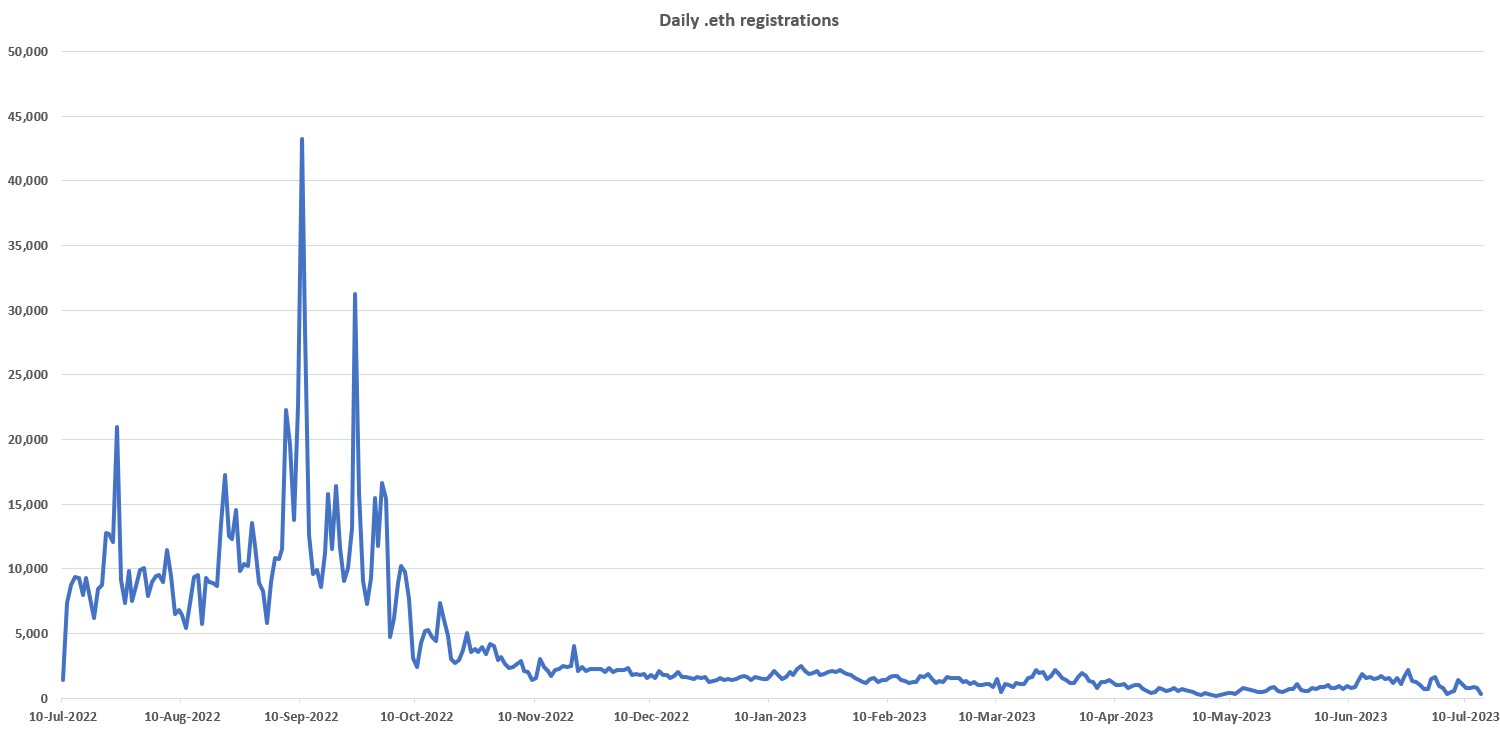
The statistics show a very large peak in activity covering roughly the calendar year of 2022, after which levels of registrations appear to have dropped off for now. This is consistent with the flurry of activity where available three- and four-digit domains were being rapidly registered, with the monthly trading volume peaking at $44.3 million in May 2022[22].

It is also possible to extract more granular data, looking at the individual blockchain domain registrations (names and registration dates), for the last year (July 2022 – July 2023)[23] (Figure 2).

Figure 2: Daily numbers of .eth blockchain domain registrations (July 2022 – July 2023)

Within this dataset of 1.47 million blockchain domains, we consider the prevalence of domains with names containing each of the top ten most valuable global brands in 2023 (according to data provided in the latest Kantar BrandZ study[24]). This dataset (see Table 1 and Figure 3) provides a measure of the likely level of potential brand infringement across the blockchain domain landscape.

Brand string
                                       
No. registered .eth domains
(July 2022 - July 2023)
                                                   
  apple 902
  google 625
  microsoft 249
  amazon 926
  mcdonalds 136
  visa 301
  tencent 43
  vuitton 119
  mastercard 66
  coca(-)cola * 160

* The hyphen in the brand string is optional, so the data considers examples containing 'cocacola' or 'coca-cola'.

Table 1: Total numbers of .eth blockchain domains registered between July 2022 and July 2023 with names containing each of the top ten most valuable global brands in 2023

Figure 3: Monthly numbers of .eth blockchain domain registrations with names containing each of the top ten most valuable global brands in 2023

It is also worth noting that the inclusion of Unicode support in the blockchain domain infrastructure allows special characters such as emojis to be included in the domain names[25]. Consequently, the dataset includes examples such as those shown in Figure 4, many of which have the potential to be used to create highly deceptive and/or purportedly official websites.

Figure 4: Examples of branded .eth blockchain domain names with names including special characters

A similar previous study published on the DNS Research Federation blog has highlighted the potential for such domains to be used fraudulently or for other infringing purposes, and identified multiple instances of prolific serial registrants, each in ownership of over 100 branded domain names[26]. The difficulties with monitoring and enforcement across the blockchain landscape also makes these domains attractive to cybersquatters[27].

Currently, very few of the branded blockchain domains in the dataset resolves to any significant content, although a small number of live sites or active website responses were identified (Figure 5). These include one webpage (Figure 5(iii)) analogous to a server index page, which is sometimes seen with sites under development as a precursor to subsequent, more significant website content, or when 'hidden' (potentially harmful) content is present in one of the subdirectories.

(i)

(ii)

(iii)

(iv)

Figure 5: Examples of live websites or other active webpage responses associated with .eth blockchain domains with names containing any of the top ten most valuable global brands in 2023 - (i) googleisadog.eth; (ii) whalevisa.eth (potentially unrelated to the Visa brand); (iii) tencentglobal.eth; (iv) googlenoodle.eth

Conclusions

These observations raise a number of questions about the likely direction of Web3 trends going forward. Arguably, there is a case to be made that the peak in activity in blockchain domain registrations took place in 2022, and has now greatly subsided. However, it may simply be that this time period simply represented a 'golden age' for registrations, when significant numbers of the highly-desirable available domain names were snapped up by prospectors; the creation of a pre-existing landscape to which future activity will be added. It is also possible that the nascent nature of Web3, and uncertainty by brand owners over which department should take responsibility for blockchain domains, has resulted in reluctance by corporations to embrace and adopt the technologies.

Furthermore, there must also be questions surrounding the use of an analysis of domains with just a single extension, on a single blockchain, as a proxy for the whole Web3 ecosystem.

Overall, however, it seems reasonable to assert that AI technologies - and other technological and societal developments - may well drive a resurgence of interest in Web 3. Given the scale of legacy activity in the associated areas, and the numbers and nature of associated infringements, it seems advisable for brand owners to be mindful of blockchain domains targeting their brands, and to carefully consider their own brand-protection strategies in the Web3 arena.

References

[1] https://www.linkedin.com/pulse/rise-nft-david-barnett

[2] https://eth.link/

[3] https://www.brandsec.com.au/blockchain-domains-and-cybersquatting/

[4] https://techcrunch.com/2023/04/18/reddit-will-begin-charging-for-access-to-its-api/

[5] https://www.reddit.com/r/apolloapp/comments/144f6xm/apollo_will_close_down_on_june_30th_reddits/

[6] https://news.sky.com/story/reddit-blackout-thousands-of-communities-are-doing-dark-today-heres-why-12899280

[7] https://www.theverge.com/2023/6/30/23779519/reddit-third-party-app-shut-down-apollo-sync-baconreader-api-protest

[8] https://www.bbc.co.uk/news/technology-66093324

[9] https://twitter.com/elonmusk/status/1675187969420828672

[10] https://www.splunk.com/en_us/blog/learn/blockchain-web3-dead.html

[11] https://www.businessinsider.com/metaverse-dead-obituary-facebook-mark-zuckerberg-tech-fad-ai-chatgpt-2023-5

[12] https://cointelegraph.com/news/how-adoption-of-a-decentralized-internet-can-improve-digital-ownership

[13] https://twitter.com/alex_valaitis/status/1674840503861248018

[14] https://www.web3domainalliance.com/

[15] https://cointelegraph.com/news/web3-domain-alliance-expands-with-51-new-members

[16] https://www.investopedia.com/terms/s/smart-contracts.asp

[17] https://fortune.com/crypto/2023/02/22/unstoppable-pledges-patent-non-aggression-pact-across-expanded-web3-domain-alliance/

[18] Unstoppable Domains, Inc. v. Wallet Inc. et al. 1:2022cv01231

[19] https://ens.domains/

[20] https://unstoppabledomains.com/

[21] https://dune.com/makoto/ens

[22] https://dappradar.com/blog/best-blockchain-web3-domain-names-services

[23] https://dune.com/makoto/ens-released-to-be-released-names

[24] https://www.kantar.com/inspiration/brands/revealed-the-worlds-most-valuable-brands-of-2023

[25] https://nptacek.medium.com/experimenting-with-ens-c88bfe7ed246

[26] https://dnsrf.org/blog/brand-names-in-blockchain-domains---new-frontier-for-brand-owners/index.html

[27] https://www.thefashionlaw.com/the-rise-in-blockchain-domains-presents-risks-opportunities-for-brands/

This article was first published on 26 July 2023 at:

https://www.iamstobbs.com/opinion/trends-in-web3-part-1-a-look-at-blockchain-domains

Monday, 3 July 2023

An overview of the concept and use of domain-name entropy

Introduction

In this article, I present an overview of a series of 'proof-of-concept' studies looking at the application of domain-name entropy as a means of clustering together related domain registrations, and serving as an input into potential metrics to determine the likely level of threat which may be posed by a domain.

In our previous studies, we utilised the mathematical concept of Shannon entropy[1], providing a measure of the amount of information stored in a string of characters (or, equivalently, the number of bits required to optimally encode the string). The idea was applied to the second-level domain name (SLD) part of each domain (i.e. the portion of the domain name before the dot - such as 'google' in 'google.com'), and broadly means that short domain names, or those with large numbers of repeated characters, will have low entropy values, whereas longer domain names, or those with large numbers of distinct characters, will have higher entropy.

The background to this analysis is the fact that domains registered for egregious purposes (such as spamming, malware distribution, or botnet creation) may be more likely to be registered in bulk by bad actors using automated algorithms[2], which typically results in the generation of long, non-sensical (i.e. high entropy) domain names, which have the added benefit of not containing brand-related keywords and are typically therefore harder to detect using classic brand-monitoring techniques. The idea is that domains registered by a particular infringer for a specific campaign are likely all to be generated using the same algorithm, and may therefore have similar or identical entropy values.

Overview of previous studies

In our initial proof of concept[3], we considered the set of all domains registered on a particular day - a sample of around 205,000 domains. The advantage also of considering a set of domains with a common registration date is that it presents the possibility for one or more groups of automated bulk registrations (which are typically all registered at the same time) to be present.

Within the dataset, a range of domain entropy values was present, from a minimum of 0.000, to a maximum of 4.700, and with 92.3% of the dataset having values below 3.500. (see Figure 1). The top 1,000 highest-entropy domains (i.e. the top 0.49%) had entropy values in excess of 3.823, and accounted for the majority of examples which appeared visually to feature 'random' SLD strings. Within this high-entropy subset, a number of additional characteristics were indicative that many may have been registered for nefarious purposes, including the prominence of use of consumer-grade registrars and privacy-protection services, and the extent of the presence of active MX records amongst these new registrations (in 27.5% of the cases - indicating that these domains have been configured to be able to send and receive e-mails and therefore could potentially be associated with phishing activity).

Figure 1: Cumulative proportion of domains with entropy less than the value shown on the horizontal axis, from the dataset in the initial proof-of-concept study

Indeed, at least one apparent 'cluster' of suspicious registrations was found to be present within the dataset, comprising a group of 125 .buzz ('dot-buzz') domains, all with an identical high entropy value (3.907), registered via a common registrar and associated with groups of similar IP addresses. At the time of analysis, many of the domains registered to Chinese-language, gambling-related websites, likely representing either an affiliate revenue generation scheme, or 'dummy' content serving to 'mask' higher-threat content which may only have been visible in specific geographic regions, or which may have been planned for subsequent upload.

In a follow-up study[4], I considered a month's worth of registrations of domains with names containing any of the top ten most valuable brands in 2022. Similarly, the high entropy domain names within this dataset included groups of apparently related, coordinated 'clusters' of domains, several of which appeared intended for fraudulent use and were consistent with registration via automated generation algorithms. For example, seven of the top eight domains in the dataset (by entropy values) had similar names of the form 'google-site-verificationXXXXXX.com' (or .net) (where 'XXXXXX' was a long string of apparently random characters), and a series of groups of 'microsoft' examples was identified, including keywords such as 'cloudworkflow', 'netsuites' and 'cloudroam'.

Comparison with other work

Other studies taking similar approaches to the analysis of domain entropy also reach similar conclusions. For example, an analysis outlined in a blog posting by Tiberium[5] states that the use of an entropy threshold of >3.1 (as an indicator of potential concern) correctly classifies 80% of NCSC malicious domains, and incorrectly classifies only 8% of the top 1000 most popular (legitimate!) domains overall (cf. Table 1).

Domain name
                                       
Entropy value
                           
  google.com 1.918
  youtube.com 2.522
  facebook.com 2.750
  twitter.com 2.128
  instagram.com 2.948
  baidu.com 2.322
  wikipedia.org 2.642
  yandex.ru 2.585
  yahoo.com 1.922
  whatsapp.com 2.500

Table 1: Entropy values of the SLDs of the top ten most popular websites according to Similarweb[6]

Additionally, an article published by Splunk[7] looking at the entropy values of fully qualified domain names, i.e. also including subdomain names - also states that high-entropy examples are consistent with the use of domain generation algorithms, and may be indicative of association with malware (e.g. in 'beaconing') and other web exploits. Comparable approaches and conclusions can also be found in a range of other studies[8,9,10], with some finding improvements in the reliability of threat determination through the use of alternative measures such as relative entropy (essentially, a comparison against the character distribution observed in a dataset of known legitimate domains, so as to provide a better measure of the randomness arising from automated algorithmic registrations)[11].

Conclusions

Domain-name entropy analysis has applications in at least two key areas of brand protection. The first of these is the ability to 'cluster' together related infringements, which has a number of benefits, including the ability to identify serial infringers and instances of bad-faith activity, for targeted and effective bulk enforcement actions. The second key area is as an input into algorithms to quantify the likely level of threat which may be posed by an online feature such as a new domain registration. Threat determination is essential in allowing prioritisation of results for analysis, enforcement, or content-change tracking.

All other factors being equal, there is some indication that high-threat domains - particularly those associated with automated registrations by domain-name generation algorithms - may have a tendency to sit at the higher-entropy end of the spectrum (and, furthermore, that domain names generated using a particular algorithm may be likely to have similar entropy values). This statement runs alongside the assertion that legitimate domains may (in general) be more likely to have lower entropy values, particularly where there is a desire for legitimate businesses to utilise strongly branded, short, memorable web addresses - as can be seen in many of the globally most popular websites.

References

[1] https://arxiv.org/ftp/arxiv/papers/1405/1405.2061.pdf

[2] https://interisle.net/sub/CriminalDomainAbuse.pdf

[3] https://www.linkedin.com/pulse/investigating-use-domain-name-entropy-clustering-results-barnett/

[4] https://www.linkedin.com/pulse/entropy-analysis-registered-domain-names-relating-top-david-barnett/

[5] https://www.tiberium.io/blog/chapter-2-classifying-domains-through-string-entropy/

[6] https://www.similarweb.com/top-websites/

[7] https://www.splunk.com/en_us/blog/security/random-words-on-entropy-and-dns.html

[8] https://hurricanelabs.com/blog/dns-entropy-hunting-and-you/

[9] https://www.logpoint.com/en/blog/embracing-randomness-to-detect-threats-through-entropy/

[10] https://suleman-qutb.medium.com/use-of-shannon-entropy-estimation-for-dga-detection-9ded275795ca

[11] https://redcanary.com/blog/threat-hunting-entropy/

This article was first published on 3 July 2023 at:

https://circleid.com/posts/20230703-an-overview-of-the-concept-and-use-of-domain-name-entropy

Thursday, 25 May 2023

The 'Millennium Problems' in Brand Protection

As the brand protection industry approaches a quarter of a century in age, following the founding of pioneers Envisional[1] and MarkMonitor[2] in 1999, I present an overview of some of the main outstanding issues which are frequently unaddressed or are generally only partially solved by brand protection service providers. I term these the 'Millennium Problems' in reference to the set of unsolved mathematical problems published in 2000 by the Clay Mathematics Institute[3], and for which significant prizes were offered for solutions. Like their mathematical counterparts, the unsolved problems in brand protection will present significant benefits for any service providers able to develop and offer comprehensive solutions.

Brand protection basics

In their most basic sense, brand protection solutions generally consist of two components: monitoring (or, strictly, detection) of brand-related content on the Internet, and enforcement action to achieve the removal of infringing material. Monitoring is most usually carried out using technological solutions intended to identify relevant material on the Internet, across a range of relevant channels, typically using a combination of methodologies, namely: (i) Internet metasearching (i.e. the submission of relevant query terms to search engines) and web crawling; (ii) analysis of domain-name zone files (see Problem 2), to identify domains with names including brand-related terms (or variants); (iii) direct monitoring / searching on known sites of interest (see Problem 1); and (iv) other techniques, such as the use of spam traps and webserver logs, as used in phishing detection technologies[4]. Many service providers will also make use of automated analysis tools, which can inspect the content of the identified webpages, and categorise and prioritise these results accordingly.

The 'Millennium Problems'

1. Social media monitoring

Whilst monitoring of content across social media platforms is a well-established element of many brand-protection service providers' product suites, it frequently remains extremely difficult to achieve anything approaching a comprehensive level of coverage. There are a number of reasons why this is the case. In general, social media content is most usually addressed using the 'direct site searching' approach (that is, using the search functionality typically in-built to the platforms themselves as a means of returning results), though some providers also have access to direct data feeds from the platforms (e.g. through an API). In general, a variety of types of content may be of interest, including brand references in usernames (e.g. associated with fake profiles), and the content of postings (e.g. associated with fraud, the sale of counterfeits, the spread of malware, brand disparagement, etc.) and elsewhere (including imagery, sponsored advertisements, and so on).

The main difficulty with the 'direct search' approach is that results presented to a user are often limited (sometimes significantly) unless the user is logged in to the social media platform. This can be circumvented by configuring a brand-protection monitoring tool to present itself to the platform as if it is a real user (with a registered account, handle (username) and password), or simply through the use of manual searches. Both of these approaches typically require the use of 'dummy' accounts and may be in contravention of the terms and conditions of the platforms themselves.

Other technological issues may also be problematic. Many social media platforms return results on an 'infinite scroll' basis (where additional results are continually added to the webpage as the user continues to scroll down through them), often with no indication of the total numbers of results which may be present, and many platforms also have specific access requirements, such as functionality only to be accessed via a mobile app (see Problem 7). Similarly, monitoring can be further complicated by sites where content is protected via the requirement to enter a CAPTCHA code, for example. It is also typically the case that the exact results returned to a user will be highly personalised, and dependent on their browsing history, interests, location, and personal demographic.

Some of these issues can be addressed through the development of partner relationships by brand-protection service providers with the platforms themselves. However, even in cases where the platforms are amenable to this approach, some of the above technological issues may remain difficult to address.

2. Comprehensive ccTLD monitoring

Another of the core elements of many brand protection service offerings is often a domain monitoring capability; that is, the ability to identify domains whose names include the name of the brand being infringed (and/or other relevant keywords). As a special subset of general Internet content, branded domain names are often of particular interest by virtue of their greater visibility (e.g. higher ranking in search-engine results) and the more explicit nature of the IP abuse (and an associated greater range of enforcement options)[5]. Branded domain names have been noted in many previous studies as being popular with bad actors in the creation of infringing content of a variety of types, including phishing sites[6], sites offering the sale of counterfeits, and sites claiming false affiliation or including disparaging content.

The primary source of data for domain monitoring is usually the analysis of zone files, which are data files published by the registry organisations responsible for overseeing the infrastructure of each individual TLD (top-level domain, or domain extension - such as .com), and which contain a list of all existing registered domains across that extension. By comparing the content of a zone file with that from the previous day, it is possible to identify new domain registrations (as well as dropped, or lapsed, domains) and filter this list for those examples containing a brand name or keyword of interest. Domain monitoring solutions can (and, in general, should) also make use of zone-file analysis to allow identification of the full pre-existing 'landscape' of registered domain names of interest, across the TLDs in question, at the commencement of monitoring (so-called 'baseline' analysis). The most sophisticated domain monitoring solutions can also automatically check for variations of the brand strings (such as typos), which are frequently used by infringers to construct deliberately deceptive domain names[7,8].

Zone files are generally available for most gTLDs (generic, or global, TLDs such as .com, .net, etc.) plus the new-gTLDs which have been launched in the period since 2012[9], but are often not published (or may not be comprehensive) by the registry organisations responsible for other TLDs, particularly the country-specific examples (ccTLDs). For this reason, detection of relevant domains across ccTLD extensions is typically incomplete, and a number of techniques may typically be used in order to fill in the gaps. These might include parallel look-ups (checks for domains with the same second-level domain name - i.e. the part of the domain name to the left of the dot - as examples identified through zone-file analysis), exact-match queries (regular searches for the existence of domains with second-level domain name strings of particular relevance, such as a brand name), and Internet metasearching. However, each of these approaches has its own limitations and, even when all taken together, there can always be domain names of potential concern which are not detected through any of these methods. The next generation of domain monitoring solutions will need to better address these shortcomings, potentially involving factors such as the use of improved algorithms to 'guess' candidate domain names for checking, and/or the use of more comprehensive indexes of Internet content. Additionally, the building of specific relationships with country registries - potentially combined with regulatory changes regarding the availability of zone files - may also be relevant.

3. Third-party subdomain monitoring

The subdomain is the section of a URL prior to the domain name, from which it is separated by a dot (e.g. 'translate' in 'translate.google.com'). The owner of a domain name can create whatever subdomains they wish, and can point these URLs to associated web content (via the configuration of DNS settings). Accordingly, subdomains can be used to create brand-related URLs, and can be associated with many of the same types of infringements as domain names themselves[10]. Subdomain-based abuse can also be particularly attractive to infringers, both because it avoids the requirement to register a brand-specific domain name[11] (which bad actors know can easily be detected by brand owners employing domain-monitoring services) and because there can be a low cost associated with the creation of the URL, particularly where a service provider allowing the free registration of personalised subdomains (such as blogspot.com) is used.

Consequently, the ability to monitor generally for brand references in the subdomain name of arbitrary URLs can be of great value. Note that this is distinct from the (relatively much simpler) problem of monitoring the existence and content of subdomains of official domains under the ownership of the brand owner 'internal' subdomain monitoring), since all of the relevant information is contained in the DNS configuration files held by the brand owner's domain-name management service provider.

Conversely, the identification of brand-related subdomains on third-party ('external') domain names is much more difficult. In many cases, this is achieved purely using Internet metasearching techniques (i.e. finding only content which is indexed by search engines in response to brand-specific query terms). Whilst this does mimic the search techniques used by general Internet users (and thereby identify the 'highest-visibility' content), it will in general not find all potentially threatening content (e.g. URLs to which traffic is driven through other means, such as links in spam e-mails). This problem can be mediated to some degree through the use of other techniques, such as passive DNS analysis or certificate transparency (CT) analysis, or via explicit queries for the existence of specific subdomain names of interest. However, these techniques require prior identification of the specific domains to be monitored; generalised identification of brand-related subdomains remains a much harder problem to solve.

4. Circumventing site blocking and geoblocking

Site blocking and geoblocking are two long-established problems in brand monitoring. The former arises when a monitored site becomes aware of repeated search queries from a particular source, and restricts access to the site from the IP address in question. A site owner may choose to do this for a number of reasons, including protection of website performance (e.g. in preventing DDoS attacks), or for compliance with their own terms and conditions (e.g. where they state that information is not to be collected for commercial purposes, such as by brand-protection service providers). Geoblocking (or geotargeting) is a related issue, whereby the visible content of a website may vary depending on the geographical location of the visitor. Again, this may be implemented by a site owner for a range of reasons, including the tailoring of content to a local audience, search-engine optimisation, security, or legal compliance[12]. However, geoblocking can also be employed by infringers as a means of evading detection, and can also present difficulties in enforcement, where it may be necessary to demonstrate exactly what content is visible from a specific remote location.

The solutions to these issues, from a brand-protection point of view, are relatively simple in principle, generally involving the use of proxies (standalone external machines serving as intermediate 'hops' through which search queries from a brand-protection service provider are routed, so as to 'mask' the originating IP address) in a range of remote locations, and/or (particularly for site blocking) the building of relationships with the sites being monitored, so that the monitoring service provider can gain permission for collecting the data. However, in practice this requires a great deal of investment in building the required infrastructure (such as hosting and maintaining the necessary proxies, and configuring the monitoring software to communicate with them) and establishing the necessary relationships. Furthermore, the construction of appropriate user interfaces to visualise and interpret the relevant information (such as the ability to compare the content of a particular website across a range of different user (i.e. proxy) locations, in cases where geoblocking or geotargeting may be an issue) can also be a complex prospect.

5. Clustering and open-source intelligence analysis

The subject areas of clustering and open-source intelligence (OSINT) are generally of greatest relevance for entity investigations, i.e. the process of using Internet searches to build a portfolio of information relating to an identified individual or website of interest. Such information can be used for a range of purposes, including background for on-the-ground investigations or goods seizures, or for legal cases, but can also be useful background for enforcement actions (e.g. in identifying clusters of related infringements for efficient bulk takedowns in a single action).

A number of technological solutions exist for visualising the links behind related entities, on the basis of common shared characteristics (such as e-mail addresses, telephone numbers, web-hosting information such as IP addresses, and so on) - i.e. 'clustering', but it is often the case that the characteristics themselves require identification through manual analysis processes. A great deal of additional efficiency can be built into the process, however, through the use of monitoring and analysis tools which can identify and extract this information automatically. This is relatively more straightforward in cases where the data can be extracted in a consistent manner (e.g. performing an IP-address look-up for any identified website of interest), and/or where the information is contained in a known location on a webpage with a fixed, pre-defined format (the 'contact details' section of a social-media profile page), such that a web scraper can be configured to pull out the content. It is a considerably more difficult enterprise to extract such information from general webpages where the structure of each page is not known in advance. In these cases, the approach generally needs to be based on the configuration of monitoring tools which are able to extract text-strings with the general format of (say) an e-mail address or telephone number. This then typically requires an element of post-processing to 'clean' and standardise the data. The next generation of clustering tools are likely to make extensive use of artificial intelligence in order to do this, in addition to also then drawing out insights between the clusters thus produced.

6. Dark Web monitoring

Dark Web content is the general name given to online material for which there are special access requirements; however in the context of online brand monitoring, it is usually taken to refer to content which is only accessible via the Tor network (a decentralised network involving the use of encrypted communications, and connections via multiple hops between Tor servers (proxies) - also known as relays or nodes). The Tor network - which is accessed using specially enabled browsers - can be used to view regular ('surface web') Internet content (and is one option open to users for whom anonymity is important), but is more usually used to access websites with the .onion extension, i.e. those which are only accessible from within the network[13].

The Tor network of .onion websites includes a range of different content types, but is notorious for illegal and infringing content and, as such, can be a key area of interest for brand monitoring. However, many brand protection service providers offer only limited capabilities in this area. This is for a number of different reasons. One significant factor is that the Dark Web is essentially unregulated, frequently with no available links to 'real-world' contact details, and extremely limited enforcement options against infringing content. However, even in cases where takedown is not possible, intelligence on the content can be extremely valuable - one example may be on 'carder' websites, on which stolen financial credentials are traded; if (say) a financial services company can determine that the details for a particular credit card or bank account are being offered for sale, this provides the opportunity for the account to be 'locked' or deactivated.

It can also be extremely difficult to configure monitoring software to search the Dark Web. Whilst it is technically relatively straightforward to configure systems to be Tor-enabled (although connections are typically rather slow), there are generally no robust indexes of Dark Web content (such as the search engines and zone files used to search surface-web content), not least because the .onion addresses for any given website - which usually consist of long, random alphanumeric strings - are generally short-lived and change over time. A number of Dark Web search engines do exist, together with ad-hoc indexes of Dark Web content posted by users on sites such as Pastebin, but the information on these sources typically becomes out-of-date rather quickly.

The nature of the content on the Dark Web also means that security concerns can be an issue for brand-protection service providers wishing to build their capabilities in this area.

7. Mobile-based technologies

As Internet engagement has continued to grow over recent years, an increasing proportion of Internet use is conducted over mobile devices[14,15], using a wide ecosystem of mobile apps. Many platforms are now almost exclusively mobile-based, often with little or no corresponding web presence - popular examples might include the WeChat / Weixin platforms, public groups on messaging services such as WhatsApp, and e-commerce platforms such as Pinduoduo. Many brand-protection service providers use legacy monitoring technologies which were designed specifically for analysing HTML content on the regular Internet and are often poorly equipped to address mobile technologies. In some cases, the work-around is to make use of standalone mobile devices or emulators - on which significant proportions of the monitoring is conducted manually - and there typically remains significant work to be done in order to fully integrate the relevant technologies into core monitoring capabilities.

8. Addressing the Web3 landscape

Web3 (also known as 'Web 3.0') is a general term referring to decentralised content on the Internet, with a particular focus on blockchain technologies. Blockchains are publicly accessible digital ledgers in which transactions are recorded, and form the basis of many digital currencies (or 'cryptocurrencies') (such as Bitcoin), in addition to a number of other applications, such as supply-chain control by brand owners. From a brand-protection viewpoint, the main related areas of interest are typically NFTs and blockchain domains[16].

NFTs (non-fungible tokens) are digital files whose ownership is recorded on a blockchain. They are most commonly associated with graphics files (such as artworks and branded imagery) or other types of digital content (such as audio or music files). However, brand owners are increasingly incorporating NFTs into their business models, including areas such as the production and trade of virtual branded items (e.g. items to be worn by avatars in virtual-reality environments within the 'metaverse', the name given to a generalised connected environment of 3D virtual worlds). Consequently, unofficial branded NFTs can be a source of concern for brand owners.

Blockchain domains - which are recorded (together with their ownership details) on a blockchain, rather than using traditional registrars and web hosting - have a number of similarities to 'classic' domain names, and can be utilised in a number of ways. The most common uses are the creation of decentralised websites on peer-to-peer (P2P) platforms, to be accessed via specially-enabled browsers, or as addresses for sending and receiving cryptocurrency. However, the blockchain domain ecosystem is essentially unregulated, and nothing analogous to domain-name zone files is available. The system is made additionally more complicated by the fact the infrastructure allows for the possibility of domain-name 'clashes' - i.e. the potential for the same name to exist independently on distinct blockchains. As with traditional domain names, blockchain domains with brand-specific names can be threat to brand owners, and a potential source of confusion for customers.

Both NFTs and blockchain domains can be traded on NFT marketplaces (such as OpenSea), and the monitoring of these sites is typically the primary source of intelligence utilised by those brand-protection service providers offering capabilities in this area. For blockchain domains particularly, this approach is less than satisfactory, and offers nothing approaching the sort of comprehensive coverage as is available for regular gTLD domain names via zone-file analysis. Some additional information on the existence of registered blockchain domains is typically available through direct searches within databases provided by blockchain domain registrars and nameserver providers; however, the problem of more comprehensive detection is much more difficult to solve, potentially involving analysis of the content of the individual blockchains directly.

Another difficulty to be overcome in service offerings relating to NFTs and blockchain domains is the issue of enforcement against infringing content. In some cases, enforcement can be carried out through the submission of a DMCA (Digital Millennium Copyright Act) notice, and some NFT marketplaces have specific takedown procedures for content which infringes protected IP. However, in many cases, this simply involves the item being 'delisted' from the marketplace in question. In the future, we may see a move towards more rigorous enforcement, potentially involving forced transfers of ownership. Part of the problem is that the legal issues surrounding NFTs and blockchain domains are, in many cases, still not well-defined and are rapidly evolving, complicated by factors such as the fact that ownership of an NFT ownership does not necessarily grant ownership of copyright for the embedded content.

Beyond #8: Other emerging technologies

As new Internet technologies continue to emerge and develop, they will bring with them new risks for brand owners and associated challenges for brand-protection service providers, who will need to continue to observe and innovate in order to stay ahead of the curve.

At any given time, it is unclear where the next area of concern will come from. Currently, there is a great deal of buzz and speculation about artificial intelligence (AI) technologies and chatbots such as ChatGPT, but it is less obvious how these may affect brand-protection considerations. In this context, I am referring to content associated with, or produced by, AI applications. (Conversely, however, it seems highly likely that AI capabilities will be increasingly built into technologies used to facilitate the brand-protection process - i.e. tools to assist with monitoring, prioritisation, clustering and enforcement.)

Users are able to communicate with AI technologies such as ChatGPT via natural language, which are then able to construct responses based on information with which they have been 'trained'. This means that the information available from a chatbot is only as good as the data with which it has been trained (essentially, in the case of ChatGPT, including large volumes of Internet databases[17,18]), and should really be treated with at least as much caution as the old "I'm Feeling Lucky" button on Google, where the user is just presented with a single response (not necessarily the most reliable one!) to any given query. This point is all the more valid given the ability of chatbots to extrapolate, and provide responses based on incomplete information. What this all means is that chatbots pose the risk of providing information about (say) a company or brand which is misleading or otherwise damaging to corporate reputation. However, since responses are generated dynamically in response to queries (rather than being 'fixed', as in the content of an HTML webpage), it is not clear how these issues might be addressed from a brand-protection point of view. Further complications surround issues such as the ownership of rights to content produced by AI technologies[19].

Where chatbots may be of particular concern from a brand-protection and cybersecurity point of view is in their ability to rapidly create content of a wide variety of types, in a range of different styles - including the ability to write and de-bug computer code. What this may mean is that the entry barrier for infringers wishing to create compelling phishing e-mails[20], or write malicious programs ('malware')[21] may be significantly diminished. The likelihood is - at least in the first generations of AI technologies - that AI will not so much change the types of attack which are possible, but rather the ease with which they can be executed[22].

Another issue surrounds use-cases in which AI systems are 'trained' with confidential corporate information as part of the process of creation of company materials (such as marketing releases). These scenarios raise the possibility for the information to be accessed by third parties, either directly via hacking, or via content included in the responses provided to other users, depending on the ways in which information is 'shared' within the infrastructure of the AI technology itself[23]. 

References

[1] https://www.cst.cam.ac.uk/ring/halloffame

[2] https://www.markmonitor.com/download/ds/MarkMonitor-Corporate-Overview.pdf

[3] https://www.claymath.org/millennium-problems

[4] https://www.linkedin.com/pulse/assessing-mediating-digital-risk-landscape-brand-david-barnett/

[5] https://www.worldtrademarkreview.com/global-guide/anti-counterfeiting-and-online-brand-enforcement/2022/article/creating-cost-effective-domain-name-watching-programme

[6] https://www.cscdbs.com/blog/branded-domains-are-the-focal-point-of-many-phishing-attacks/

[7] https://www.cscdbs.com/en/resources-news/threatening-domains-targeting-top-brands/

[8] https://www.linkedin.com/pulse/hyphenated-domain-infringements-david-barnett/

[9] https://newgtlds.icann.org/en/about/program

[10] https://www.cscdbs.com/blog/the-world-of-the-subdomain/

[11] https://www.linkedin.com/pulse/exploring-domain-hostname-based-infringements-david-barnett/

[12] https://www.cscdbs.com/blog/do-you-see-what-i-see-geotargeting-in-brand-infringements/

[13] 'Brand Protection in the Online World: A Comprehensive Guide' by David Barnett (2016). Chapter 11: ''Deep' and 'Dark' Web'

[14] https://www.statista.com/statistics/617136/digital-population-worldwide/

[15] https://www.linkedin.com/pulse/holistic-brand-fraud-cyber-protection-using-domain-threat-barnett/

[16] https://www.linkedin.com/pulse/rise-nft-david-barnett

[17] https://www.sciencefocus.com/future-technology/gpt-3/

[18] https://techcrunch.com/2023/03/23/openai-connects-chatgpt-to-the-internet/

[19] https://intellectual-property-helpdesk.ec.europa.eu/news-events/news/intellectual-property-chatgpt-2023-02-20_en

[20] https://securityboulevard.com/2023/01/what-does-chat-gpt-imply-for-brand-impersonation-qa-with-dr-salvatore-stolfo/

[21] https://www.digitaltrends.com/computing/chatgpt-created-malware/

[22] https://venturebeat.com/security/security-risks-evolve-with-release-of-gpt-4/

[23] https://blogs.blackberry.com/en/2023/04/is-chatgpt-safe-for-organizations-to-use

This article was first published on 25 May 2023 at:

https://circleid.com/posts/20230525-the-millennium-problems-in-brand-protection

What enforcement really looks like and why two infringement issues are never the same

Brand protection programmes typically consist of a number of key phases: Monitoring: The identification of results of potential interest Ana...